Showing posts with label writing. Show all posts

Saturday, November 12, 2022

AND THIS SHALL BE FOR MUSIC: MY CREDO


This morning, November 12, 2022, I  released my sixteenth book (fifteenth novel), And This Shall Be for Music.In many ways, I believe this is the book I’ve always wanted to write. The primary purpose of the book is to share the immense power music can have in our lives. I see it as the most powerful force in the universe, and I’ve said that in many different ways in most of my novels.

 I first met the character Lindsey Cameron when I was writing the two books in “The Cameron Saga.” In Memories of Jake, she was the much-longed-for and much loved first child of Andrew and Mary Cameron, born after Andrew had been treated for PTSD and had begun his successful career as an artist. Near the end of the book, we learned she hoped for a career as an opera singer. In Man with No Yesterdays we again encountered Lindsey and learned she was quite a determined young woman.

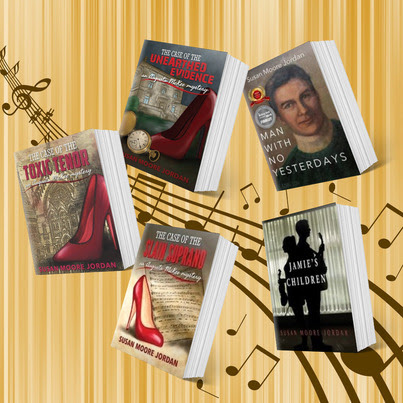
 Lindsey wanted me to tell her story, but in 2017 I obviously was not ready to do that and instead embarked on a series of murder mysteries which were great fun to write. The first two volumes in “The Augusta McKee Mystery Series” were released in 2019, and over the next three years, during which time our world turned upside down, writing the mysteries was truly an escape for me…going back to Cincinnati, the city I love most, and the 1960s, the time I lived there.

 After releasing book eight in the mystery series, I felt ready to tackle Lindsey’s story. I knew it was not going to be an easy story to tell—Lindsey had to deal with some extremely difficult situations as a very young woman. Near the end of her undergraduate study at the Conservatory of Music in Cincinnati, in the early spring of 1996, her two housemates were in a freak accident and one was killed, the other badly injured, including the loss of his lower right leg.

 I had written about four chapters in 2017 and went back to that material, which needed to be reworked. I began in December of 2021 and completed Lindsey’s story only recently. Writing a long, character-driven book after eight much shorter mysteries required a different rhythm to what I was doing, and many rewrites. But I think I’m ready for my new baby to meet the world. Early readers have given me very strong, positive responses, and all agree this book is the most powerful and most personal novel I’ve written.

From a beta reader, Ken Van Camp: “Wonderful job, your best book yet! I would recommend this book to people dealing with a great personal loss, as it does a beautiful job of showing people working through the grieving process, and coming out the other side of recovery. Of course, the music therapy is a strong and original theme, and the character development is outstanding.”

A long-time friend who has been active for decades in the entertainment and film industries agreed to read an ARC (Advanced Reader Copy) and had this to say: “A tremendous piece of work that resonates in so many different ways—in particular the way music affects us in a way that nothing else does.”

 Comments such as these are definitely heartening. However, there is still that writer’s trepidation about releasing this work, in which I bare my heart and soul to the reader.

But that’s life, isn’t it? And in truth, it’s why I write. To share that which is my passion.


Available on Amazon, print edition and Kindle:

https://www.amazon.com/gp/product/B0BJF7M1WG/ref=dbs_a_def_rwt_hsch_vapi_tkin_p1_i1


Monday, April 18, 2022

The Wonderful World of Opera in America

 I’m staring at a page that’s about three quarters written, and the heading says “Chapter 27.” But I’m wondering if this book is ever going to be finished. This is first draft, and I feel like I’ve been swimming through a river of mud and driftwood during the last few chapters. I’m supposed to enjoy writing. I want to enjoy writing. I have enjoyed writing. Right now, though, it feels more like an arduous chore.

 I heard my first opera in the fall of 1952. I was fourteen, listening to a Saturday Metropolitan Opera broadcast of Claude Debussy’s Pelleas et Melisande (sung in French, of course). It was love at first…well, hearing. In the fall of 1955, I became a freshman at the Cincinnati College-Conservatory of Music, thrilled beyond belief to have been accepted as a vocal performance major.

 This is a preamble to the book I’m attempting to write at this point in my second career as a writer, which began nine years ago at the age of seventy-five. I’ve written fifteen books, much to my astonishment. All of them include music. Music has been my life since even before that fourteen-year-old impressionable child became enamored of opera, thanks to a father who loved classical music (though opera wasn’t his thing). Even my eight-book cozy mystery series overflows with music. Some people love these books (it would be nice if there were more readers, but I think my protagonist Augusta McKee—singer/teacher/amateur sleuth—has a small but loyal following).

 My years at CCM were a dream come true. As a freshman, I realized fairly early on that my voice was one of those described thusly: “she has a small voice, but it’s pretty” (any singer will know exactly what I’m saying…at least it wasn’t “small, but ugly”). It was a real eye-opener to hear some of my schoolmates—indeed, some of my classmates, who had large, mature, thrilling voices. Wisely, I realized singing at the Met was not going to happen for this soprano. That was okay, I still loved opera and wanted to somehow be part of that world. Then I met this tenor.

 Yes, I fell madly in fatuation (I just made that up) and fairly soon we were married. He had a true talent, and for about a decade managed to sing professionally. I did everything I could to support his dream. Or what I thought was his dream. After those ten years, he decided the life of an opera singer wasn’t for him, and instead established himself as an independent notesetter for music publishing companies. He liked his new career, and I accepted it. He loved to sing, but he never truly loved singing opera. (His acting ability was not on a par with his singing ability, but that didn’t prevent him from continuing to sing right up until his death fourteen years ago.)

 Three children later, we left Cincinnati to move to Northeastern Pennsylvania so the notesetter could be close to his primary customer. He then suggested I establishing a private vocal studio, and that’s when I realized my true calling. Because of that “small, but pretty” voice I had worked hard to develop my own instrument. While my voice was never suited for opera, I had become a decent singer, thanks to the three excellent teachers I worked with. What I learned, I loved teaching to young singers, and it turns out I communicated vocal technique to them well, along with my passion for classical vocal music. I believe in the past forty-three years nearly every student who came into my studio left with a better understanding of their voice, and some continued their music studies in college. Some even built careers, which was tremendously gratifying for this teacher.

 So, the book I’m attempting is about a young aspiring opera singer, beginning with her graduation from “the Conservatory” (translation: CCM) in 1996. It should be easy, right? I’ve been on the fringes of “Opera World” for decades, and even lived there with the tenor for a time back in the sixties. Not so. The “landscape” of opera in the United States changed dramatically beginning sometime in the sixties, and while at that time there were two major opera houses in this country (the Met and San Francisco) and three regional opera houses…that adds up to five…these days the organization Opera America has a list of ONE HUNDRED FORTY-NINE major and regional opera companies on their list. And there could be even more.

 This showed me that my protagonist, Lindsey, has a lot of decisions ahead of her, so I needed to learn all about the growth of my favorite art form over the past five or six decades. How does an aspiring opera singer build a career in more recent years? She has many paths, but also much competition.

 On top of that, because of a trauma in her young life, Lindsey becomes aware of music therapy, the Bonny method of Guided Imagery with Music in particular. Something else I’m researching because until I started writing this book, I had never heard of GIM music therapy.

 So. Here I am, up to the first draft of Chapter 27 and my outline shows potentially 32 chapters (it could be one or two more). You’d think the finish line would be in sight. And yet, lots of logs and debris in this river as I thrash and splash my way through.

 Opera in America is as much of a production offstage as it is on. Those who love the art and try to make it happen face challenges, sometimes traumatic, that can change them. This next story shows how people react to what a life fraught with trials in opera can bring, seen through the eyes and experiences of my soprano Lindsey.

 Am I having fun yet?

 Well…I am. In a weird sort of way. Which only means I’m a writer. Right?


Thursday, September 9, 2021

THE MAGIC OF MEMORY


I should ask an expert if memories and imagination are somehow intertwined because at this point in my long life I'm putting memories and the ideas they sometimes produce down on paper, so to speak. Since 2013, I’ve written thirteen novels and am currently at work on a fourteenth.

 In a work of fiction, everything our characters say and do is the result of what we imagine happening to them. And not always, but often, it’s something we, or a friend or family member, personally experienced. Or something we read about somewhere, or perhaps learned through research. We then try to apply this information to what we want to happen with our characters. While I occasionally have to search through my memory banks, I’ve been blessed with considerable retention, and recall nearly always comes. I started writing at the age of seventy-five, so those are pretty big memory banks!

 Not all memories are beautiful, of course. And having a good memory sometimes means sleepless nights regretting past bad choices, going over a long list of things done and not done which might have meant a different life. It’s a pointless exercise and thankfully, I don’t do it too often. And it’s a trade-off I can live with, and do so gratefully. I’ve seen first-hand the devastation caused by dementia and I’d rather deal with my bad memories than lose them.

 Maybe this piece isn’t so much about memory as about the remarkable capacity of the human mind and its ability to create. How does that actually happen? With me, it began with a considered recall of a traumatic experience from my teenage years, and an attempt to feel what a close friend did when both her parents were shot to death one horrible night in January 1954, by her estranged brother-in-law. And in the aftermath, how she found the courage and fortitude to go on with her young life, playing the leading role of Julie Jordan in Rodgers and Hammerstein's musical drama Carousel, in which Julie's husband takes his own life and leaves her alone to raise their child.

 I wrote my first book, How I Grew Up, in the first person, setting myself the daunting task of attempting to live another person’s pain. In Man with No Yesterdays, I went even further, trying to put myself in the head of a Vietnam veteran who had suffered a traumatic brain injury and lost all memory of his former life. Imagine having to live with such an enormous loss.

 Not long ago a high school friend with whom I communicate regularly reminded me of a day trip with a mutual friend—actually, the principal character in How I Grew Up, Anita Barker (she’s Melanie Stewart in the book, which is a roman à clef). My friend Audrey even sent me photos from this trip taken in the summer of 1954. I still can’t remember that trip, and my failure to do so gave me a glimmer of understanding for my character Jake Cameron.

Currently, I’m writing the eighth—and perhaps final—novel in my mystery series, which is set in Cincinnati, Ohio in the nineteen-sixties. My time in that lovely city began in the fall of 1955 when I matriculated to the College-Conservatory of Music. Locating “The Augusta McKee Mystery Series” in a city I fell in love with at seventeen and delighted in for sixteen years has awakened many happy memories. Thanks to the marvels of the internet, I've been able to affirm nearly everything I need to double-check particulars about my time in Cincinnati. (Not the least of these tools are Google maps which have helped me numerous times revisit different areas of the city and trace the exact routes I drove.)

 When I published How I Grew Up I at first thought it would be “one and done”—I’d actually written a book. But it was only the beginning, as one story brought to mind another that I needed to write. That has continued for over eight years. I’ve set all my books in the past, during remembered times, with many containing remembered events. Books that sprang from my mind, my imagination—and my memories.

poster for The Pocono Cinema and Cultural Center 

designed by Katy Schulz Burton

For more information please visit my website, www.susanmoorejordan.com


Friday, June 4, 2021

LET MUSIC LIVE

 In the late spring of 2019, I learned The Guardian was looking for essays for a series entitled “How I Fell in Love With …” and on a whim, sent an email to the editor who was running the series. It was fun to write and let her know about my newfound passion, writing books—“music-centric” books, after a full, rich, and happy life as a musician. Much to my amazement, she contacted me within a day or so and asked me to write the article. No deadline, roughly eight hundred words, just expand what I’d sent in my slightly breezy email.

 Needless to say, I set to work immediately and was even more amazed when a week or so later I received notice that the article would go online on Friday, May 24. Friday Sydney time, actually. I still was having a hard time processing this, but late Thursday night (PA time) I saw the article online. An article I wrote. In The Guardian.

 I shared it all over social media, and early the next morning contacted my sons, both of whom live locally, to share my good news.

 Instead, I learned of an awful tragedy. My oldest son runs his own business, providing soil treatment for playing fields, mostly golf courses, from parts of the greater New York City area into Connecticut and Long Island. One of his most valued employees, and a good friend to boot, had drowned in a freak fishing accident Thursday evening. Twenty-nine years old, sole provider for his family; two children, ages one and three. He was a very good friend of my younger son who also works for the company. My sons were heartbroken.

 It was one tragedy in the hundreds that happen every day. The pandemic that struck the world the following year, and which we are still experiencing, has caused many such valleys in so many lives. It’s often said, “None of us get out of here alive,” and that is a certainty, but the death of a vital young person is difficult for everyone to process. We go through our lives, aware we could be involved in such a tragedy, but certainly not anticipating it. To my mind, a good thing—we can’t live in constant fear of the bad thing that might be lurking around the next corner.

 I am grateful beyond words for the music in my life. My personal motto is “Music—the most powerful force in the universe.” Music can help us grieve, can help us heal, can inspire us, can elevate us as nothing else can. After my week of peaks and valleys, I attended a high school choral concert a few nights later and heard a wide variety of music sung by some great young people, who loved what they were doing and performed exceptionally well.

 The final selection on the concert was a powerful and deeply moving choral piece by Joseph Martin, “The Awakening,” which speaks of a world without music. How silent, how sad. The kind of world we’ve been living in for many months. The final part of the song is based on the composer’s personal experience of emotional healing through his music ("Let music never die in me, forever let my spirit sing.") It ends with a burst of brilliance: “Let music live.

 Music is the constant in my life, as I wish it could be in everyone’s life. It’s our connection to heaven, wherever that may be. It’s a gift from our Creator, whatever we may call him. It helps us survive the valleys and delight in the peaks. It elevates and enhances our existence. It makes life worth living.

 Let Music Live.


Tuesday, December 31, 2019

Time Flies and Other Pithy Comments


When I was in high school in the 1950s and considered that the millennium would change in some fifty years, I honestly wondered if I’d be around to see it. I think the average age expectancy at that time was mid-sixties for men, around seventy for women, so that isn’t as far-fetched as it might sound these days, with more and more of us living into our eighties and nineties.

I’m glad I’m still around, though I’m also surprised I’m still here and about to turn eighty-two. The second decade of the 2000s was pretty eventful for me. In 2013, after a full lifetime as a musician, I wrote and published my first book. Six years later I’m at work on book number eleven.

Thanks to Katy Burton for the beautiful poster

 My voice studio, which I opened in 1979, is flourishing, and I’m thrilled that after forty years I can continue to help young men and women unlock their voices. Some of my students have made music their life’s profession. One former student has been with the Metropolitan Opera Chorus for twenty years, and another has been singing with the Deutsche Oper Berlin for five years and is now appearing as a guest in other major opera houses in Europe. One had a stint on Broadway. Others have established themselves as teachers, either in schools or with private studios; performed in regional theaters and on national tours. Hopefully, all of them continue to sing, maybe in community musicals, a church choir, or blowing people away at karaoke!

For over thirty years, beginning in 1984, I was stage director for eighty musical theater productions for both community groups—most notably, Pocono Lively Arts—and two different high schools (at different times). I retired from directing in 2015. I wrote a book about that in 2016: “More Fog, Please”: Thirty Years Directing Community and High School Musicals. For a few weeks, it was listed as a “hot new item” and was an Amazon best-seller in its genre. (I held a book launch party at the local Panera Bread.)

Musical theater friends Michael Drolet, Kelly Foley, Dale Foley

In 2017 I released two novels set in the Vietnam War era, “The Cameron Saga”—books that followed the lives of two brothers who served in the war and struggled to deal with its effect on their lives and the lives of those who loved them. The first book, Memories of Jake, was submitted to the Wishing Shelf Book Awards, and it received a Red Ribbon Honorable Mention, much to my delight. The best part of writing those books, though, was connecting with Vietnam veterans and helping establish an annual observation of National Vietnam Veterans Day at a local, independent movie theater. I’ve made some remarkable new friends.


Exterior and Interior of the wonderful
Pocono Cinema and Cultural Center
where we hold our Vietnam Veterans Day Event
  In 2018, I released the first novel in a mystery series entitled The Case of the Slain Soprano. I’m currently at work on book #5 in “The Augusta McKee Mystery Series” and having a great time writing it. The Case of the Slain Soprano won a Finalist Award with the Wishing Shelf Awards and a Semi-Finalist for the Kindle Book Awards.

I was honored and thrilled by these awards. I found them validating and encouraging. My books aren’t for everybody: they all contain music, even the mystery series. Many of my characters are musicians, and music is a vital part of their lives. I like writing about music, and I’ve had many nice reviews which comment on the way I write about it: the emotions experienced by my characters as performers and listeners.


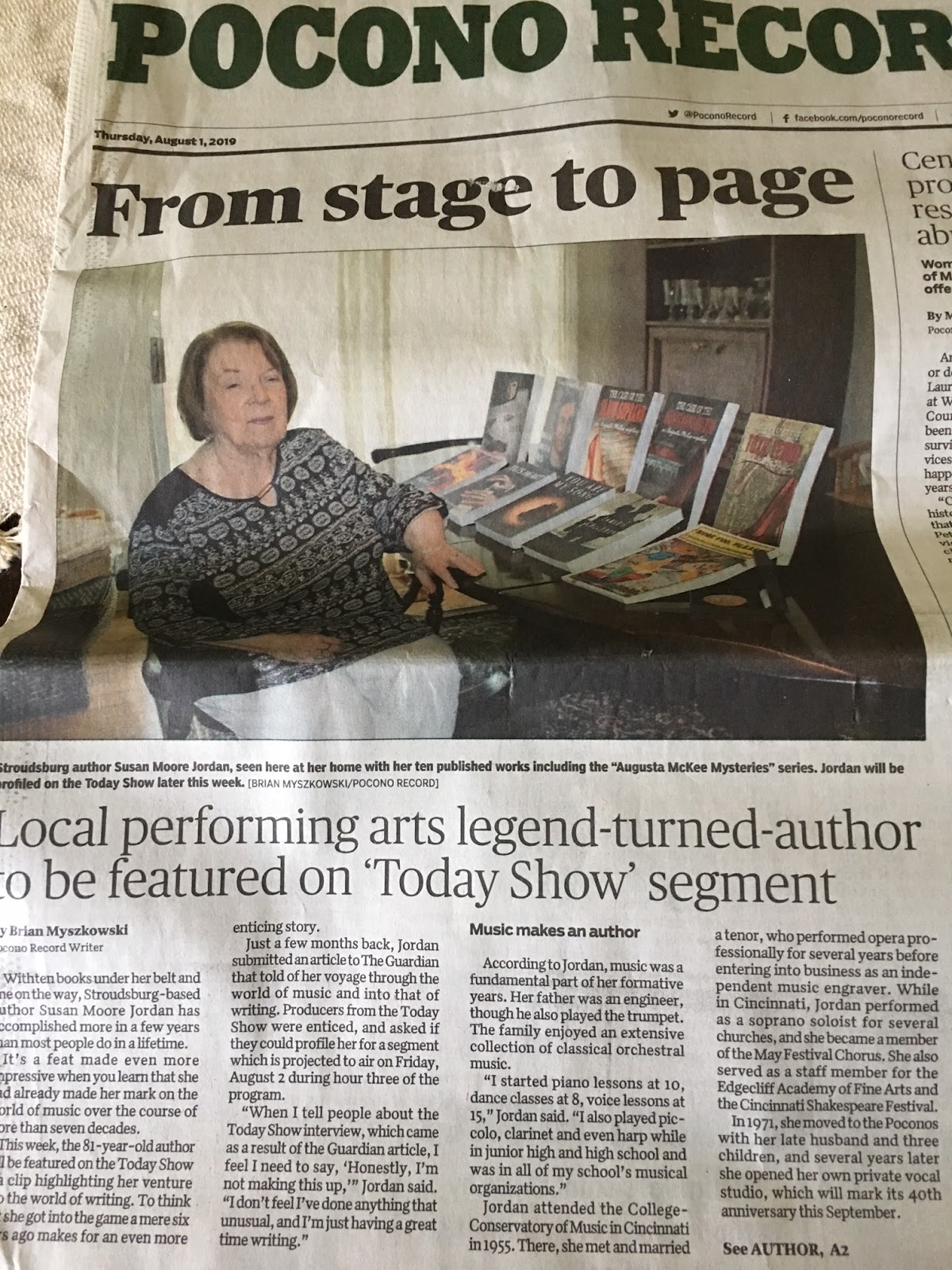
A couple of pretty exciting experiences for this indie author in 2019: I had an article published by The Guardian, and I was featured on the Third Hour of the “Today Show” over the summer. Both of these as a recognition that at the age of seventy-five I had begun to write and I’m still at it! I will say, though, that every time I start a new book I wonder if I’ll finish it. At my age, how could I not wonder that? But I’ll keep writing as long as my eyes, my fingers (I use the computer for everything) and my mind hold up.

How about that? Front page, above the fold.

We’re about to enter the third decade of the millennium that I at one time doubted I’d ever see. I guess I should try to say something pithy and meaningful at this point. How about this, a quote from the great Yogi Berra: “It ain’t over ’til it’s over.”

Wishing you all the best for the coming year. Peace, hope, and love.


Please check out my author page on Amazon:
or visit my website, which has links to purchase all the books. The novels are also available as e-books.

Monday, September 30, 2019

Tell Me Again Why I'm Doing This?


"Give someone a book, they'll read for a day. Teach someone how to write a book, they'll experience a lifetime of paralyzing self doubt."—Lauren DiStefano, author of Burning Kingdoms

Book number eleven, novel number ten, “Augusta McKee Mystery” number four, is waiting for me to hit that magical “Publish My Book” button on Kindle Direct Publishing. Yikes. 

 Every time I get to this point, I have this moment. What in the world am I doing? Despite all the edits, proofreads, read-throughs by beta readers, this book has to have mistakes in it. Beginning with the entire concept of the story. I should just sneak away and forget about releasing it – despite the fact I’ve already announced that it will be available October 1. Two days from today. 
 What would happen if I reneged, other than my having a large amount of egg on my face? The sun’ll come up tomorrow. (I know you sang that, I just did.) Grass will grow, flowers will bloom, the rivers will continue to run.

This is my child, my precious child, I’m about to push out into the cold, cruel world. Will it get a cold shoulder or a welcoming reception? Will anybody read it? Will the people who read it like it? Maybe I should let it stay home today. Or for a month. Or forever. I’ll read it.

My author friends assure me all of us go through this period of self-doubt. That’s really kind of a mild way of putting it. It’s more like a sense of “whatever possessed me to sit down at my computer and start putting words together when I have no idea what I’m doing and I have absolutely no business doing this.”

And if you think it will get better with time, I fervently hope you are correct, because at this point it’s gotten worse with every book. While I’m writing it, I have the greatest time imaginable. I completely lose myself in the book. My characters take over my life. I dream about them. I tell them to please go sit in the corner so I can go to the bank and avoid wrecking my car in the process. I’m sure I walk right past friends in the supermarket and don’t even see them because Augusta or Malcolm is talking to me about a plot point. And before those two, it was Andrew and Jake Cameron. They had my attention for over two years. 

Oh, I will follow through and click on that box, and watch The Case of the Purloined Professor go live on Amazon, and I’ll spread the word via social media that it’s available. And wait anxiously for the first reviews (and wish more people would kindly consider writing even a couple of lines for a review … we just never get enough, unless our name is Stephanie Meyer or John Grisham or Stephen King. Or the ex-billionaire, J. K. Rowling).

I truly am enjoying writing this mystery series. I like Augusta McKee and Malcolm Mitchell and their friends and family. It’s a thrill to feel that Augusta has a following, and I hope it continues to grow. I love that I’m learning so much about police work, its demands and intricacies (with many, many thanks to Stephen Kramer and the Greater Cincinnati Police Historical Society and Museum), and the limitations policing had in the mid-1960s—despite which they did remarkable work. Our law enforcement officers are dedicated, effective, and some of the bravest people on

the planet.

 There’s my answer … I do it because I love what I’m learning, and I love being able to share it with the nice people who read my books. After all, that’s what art is. A means of sharing our passion, whether it’s art, music, dance, theater, or literature. And I’m blessed with the desire and, it seems, the ability to share my passion for music through literature.

Yes, I guess I just answered my own question. Get ready, The Case of the Purloined Professor. You can do this. October first! Get out there and do your stuff!

Thank you for your support, dear reader. It means more than you know.


Wednesday, August 7, 2019

Research: Up Close and Personal


When I first started writing, a friend recommended that I read Anne Lamott’s wonderful book Bird by Bird. Direct and to the point, Lamott gives the first-time writer encouragement and suggestions. One suggestion that impressed me was this:

There are an enormous number of people out there with invaluable information to share with you, and all you have to do is pick up the phone. They love it when you do, just as you love it when people ask if they can pick your brain about something you happen to know a great deal about — or, as in my case, have a number of impassioned opinions on.

Beginning with my second book, Eli’s Heart, I knew I was going to need to pick up the phone Ms. Lamott makes reference to. My principal character was born with a daunting congenital heart disorder, and a prodigious musical talent as a pianist. I know a little about playing piano but certainly not at Eli’s level. And I knew zero about Tetralogy of Fallot, the heart disorder.

I found Ms. Lamott was absolutely correct. It has been my good fortune to have crossed paths with many people of diverse talent during my lifetime. A young man who had performed the leading role in a musical I directed during his high school years, Dr.
Dr. Andrew Rennekamp
Andrew Rennekamp
, was a medical researcher at Massachusetts General Hospital when I began Eli’s Heart in 2014, and through him I connected with a cardiologist, Dr. Aarti Asnani, who was generous with her time and expertise to the point of doing research of her own as to how T.O.F. was treated sixty years earlier. 
Dr. Aarti Asnani


And a dear friend who is a remarkable pianist and a great teacher, Scott Besser, talked to me about what it felt like to face the challenges and the emotion of the musical literature Eli performed.

Scott Besser, Chris Souza
From that point on, with each succeeding book I’ve needed to phone at least one person for help with writing what I don’t know. The joy of that is how much I’ve learned and been able to convey through these novels. For Jamie’s Children, my character Laura is a violin prodigy. As much as I love hearing violin, I know very little about what it would be like to play the instrument. Another local musician and friend, the exceptional violinist and teacher Chris Souza, talked to me, read through some passages (just as Scott had with Eli’s Heart), and I began to get into Laura’s head.

Her brother Niall was an even greater challenge. Niall suffers from bipolar disorder and aspires to be a singer-songwriter. Mental disease—and in particular, bipolar disorder—is 
Nate Taylor
Dr. Andrew’s specialty. He was an enormous help, suggesting books and articles, and discussing the disease with me.

 A former voice student, Nate Taylor, who is an aspiring singer-songwriter, walked me through his journey and read my attempts at what it felt to perform great music such as “The Sound of Silence” as well as creating one’s own music.

More recently, writing about two brothers who survive service in Vietnam, only to be faced with the aftermath of emotional and mental stress, required a great deal of study about the war and what our military endured during those years. The two books in “The Cameron Saga,” Memories of Jake and Man with No Yesterdays, cover the war from the Gulf of Tonkin Resolution to the fall of Saigon.
Col. Charles Vincent
After much online research, reading a number of mostly first-person accounts, and watching videos and films, through another former voice student I was put in contact with a remarkable man, Lt. Col. Charles J. Vincent, U.S. Army Corps of Engineers, a veteran of Vietnam and also of the Korean War. Again, I presented Col. Chuck with a list of questions he patiently addressed, and he agreed to read sections of both books to give me his suggestions and corrections. He even gave me the scenario for one brother’s final combat mission. I was fortunate enough to meet Chuck and consider him a friend.

For my latest venture, a mystery series set in the city I love, Cincinnati, in the 1960s, I needed assistance with police procedure
Lt. Stephen Kramer
overall and in particular during that era. Through the website for The Greater Cincinnati Police Historical Society and Museum, I connected with retired Lt. Detective Stephen Kramer. When I wrote the first book in 2018, Lt. Kramer was President of the Society; he continues to be active as its Archivist
. A writer himself, he understood what I was looking for and he has been kindly available for thus far four books in the “Augusta McKee Mystery Series.” He’s done more than help me with police procedure; he’s become vital in developing the character of Homicide Detective Malcolm Mitchell. It’s not at all unusual for Malcolm’s words to actually have come from an email from Lt. Kramer, with his kind permission.

In my personal experience, I haven’t found writing to be “a lonely profession” at all … not with the contacts, encouragement and support of remarkable people such as these. They’re part of my world.

**
All my books are available on Amazon. You can find links to order 
on my website: www.susanmoorejordan.com
Or on my Amazon author page https://www.amazon.com/Moore-Jordan-Susan/e/B00IBZ731U


Sunday, December 30, 2018

Why I Write, Take Two


My book editor, Ashleigh Evans, is a former junior high school friend from the 1950s, who I knew as Betty Smith (this was before her career as a performer, hence the name change). We lost touch for many years until one afternoon in the 1970s I was watching my late husband play tennis and a man walked up to me and asked, “Did you used to be Sue Moore?” He was Bill Smith, a local attorney. But I remembered him as Billy, Betty’s annoying kid brother.

I had an opportunity to see Ashleigh not long after that when she was back east and was in our area to visit Bill and his family (she now lives in the San Francisco Bay area). Bill’s daughter, Kristen, has followed in her aunt’s footsteps and is a talented performer who is now on Broadway, her lifelong dream.

But I digress. Ashleigh read my first novel, How I Grew Up, and contacted me to offer her services as copy editor, looking for errors in spelling, punctuation, and grammar. Over the course of nine books she has become much more. She also catches plot holes and advises me when I veer off track, so she has also become my content editor and in a way, my partner. We exchange ideas. I’m very fortunate because she will take the book as I write, a chapter at a time, something very rarely done.

Recently I sent her what is the climactic chapter for my work in progress, The Case of the Toxic Tenor, a murder mystery. When she returned the manuscript with her corrections/changes/comments she remarked in the email: “When you're writing exciting, fast-paced scenes like this, do you tend to type faster and faster?!”

That made me laugh, because I certainly do exactly that. But I do more. The world around me recedes and I am living right there, in that moment, in that place. This particularly scene takes place in 1964 Cincinnati, in the lobby of the Netherland Hilton Hotel. I was in that lobby a number of times when I lived there, and had a vague memory of its elegance, and of the Palm Court Restaurant just off to one side. But this is an intense scene and I needed more. Internet searches provided some great photographs and helped put me there. My remarkable police procedure consultant, retired Major Crimes Detective Lieutenant Stephen Kramer of the Cincinnati Police Department, included detailed narration to accompany photos he sent. I was right there in that lobby, watching the scene unfold as I wrote.

I had an absolute blast.

When I am writing I have the time of my life. And it’s immensely rewarding when I occasionally hear from someone who has enjoyed one of my books, whether through an Amazon review, an email, a note, or a comment in a parking lot (something like “I borrowed one of your books from my neighbor and I just loved it!”). I started writing in May of 2013 and it has become as essential to me as breathing (I know I’ve said that before, but it’s true). I’m sure I’m not that unusual and many other writers share my passion.

Sometimes people ask me how to write. Just do it. Sit down, use your computer, use a pencil and a pad of paper … just put the words down. It doesn’t have to be perfect. It won’t be perfect. Get the story out of your head. You can go back later and fix things. And you will, many, many, many times. But my advice is this: don’t read a bunch of books on “how to write a book.” Just start writing. Even if it’s slow going at first.

Without my computer, the internet, and some incredible people kind enough to generously share their knowledge and expertise about subjects I know little about (Lt. Kramer is a gold mine), I couldn’t write. I know that. And when I look at the nine books I have in print, I’m kind of stunned.

If you have any desire to write, try it. It’s cathartic, it’s escapist, it’s freeing, it’s gratifying and satisfying and fulfilling. Once you get into it, you’ll feel alive in a way you never have before. You’re creating something. Just think of the implications of that. Using your ability to produce something entirely new. Oh, sure, I know similar stories have been told numerous times. But not this exact story, in these exact words.

That’s why I write.

Oh, just in case you’d like to read any of my books, the quickest and easiest place to go is my Amazon author page. You can check out the reviews while you’re there. And if you do read a book … a review is like gold to us indie authors.  
https://www.amazon.com/Susan-Moore-Jordan/e/B00IBZ731U/ref=dp_byline_cont_ebooks_1


Friday, June 29, 2018

Music to My Ears


Have I mentioned how much I love to write? It never ceases to amaze me how, at this point in my life, I have found a new passion. After a lifetime as a musician, stage director, and teacher, I am actively creating. I loved what I did (and still do, I continue to have a private voice studio), but that was developing other people’s talent, organizing other people’s talent, recreating the original works of composers, lyricists, and writers. This work is from me—heart, mind, and soul.

Marketing is something else entirely. It’s time-consuming, requires some expenditure of money I don’t really have (if you want to write, do not do it with the idea you will become rich and famous!), and just plain tedious. I still don’t “get” Twitter and now I’ve established an Instagram account and really don’t know how to use it effectively either.

A very helpful tool in marketing is reader reviews that appear on Amazon. I have some reviews, and I’m happy that some of my readers have enthusiastically shared their appreciation for my books. I wish more would do so, but I can’t seem to find the magic formula to make that happen. Reviews are like a standing ovation for a writer. They don’t need to be lengthy, but if they are positive and encouraging, they may inspire a potential reader to buy a book!

One thing I am very grateful for are those readers who, while not posting a review, send me one. Readers who take the time to write an email, or a message on Facebook, or a note they put in an envelope and put a stamp on to tell me they appreciated one of my books. Here are a few I received recently, and these truly are music to my ears and a great encouragement.

From a neighbor:
“Finished Eli's Heart last night. It was beautifully written and so very emotional. It touched my heart and made me cry. Just thinking about it makes me tear up. I can see why some people might think it would be good as a series, but I prefer being able to get to the next part immediately! I actually like longer stories when they are good ones, because I don't want them to end. You can be very proud of that book!”


From a fellow musician (who was reading while she was part of a pit orchestra during an extended run of a musical theater production):
“Oh no! I've finished all your books and I still have 4 shows left!! They were absolutely magnificent. I'm glad I waited till they were all published to read them straight through. I'm horribly impatient when it comes to wonderful writing! Thank you for sharing your ‘new’ gift with the world!!”


From a local resident who participated in some of the shows I directed:
“I recently read your book, ‘More Fog, Please’ and enjoyed it thoroughly. I remember so many of those wonderful plays you directed over the years and participated in several. You have enriched our community with your gifts. Best wishes on your writing career now!”

Thank you, readers, for making the time to respond to my work. It’s appreciated more than you know!

Please visit my website www.susanmoorejordan.com
for links to all my books


Sunday, April 9, 2017

The Crazy Writer Lady

Since I started writing seriously … or should I say seriously writing … something has happened to me. I find that I live in whatever book I’m working on more than I live in the real world. I wake up with thoughts about my characters and sit at the computer to put them “on paper.” Sometimes I do this at 3 a.m. I live with a cat. She doesn’t mind my odd hours.

Of course, I do have to spend time in the real world. I have to pay bills and feed the cat and check on my children and grandchildren. But my worlds overlap all the time. I can be wandering through the supermarket and have a sudden answer to a knot in a plot and have to hang onto the thought (see what I did there?) until I get home. Instead, someone I’ve known for years says hello and I struggle to pull myself back into the twenty-first century (all my novels take place in the twentieth century) and remember who in the world this person is.

I’ve become the crazy writer lady. Since I’m approaching the milestone birthday that marks me as older than God, I’m sure some people attribute all this to advancing age. I don’t feel old, but I definitely feel distracted. I need to get back to the twentieth century to work on my book.

My background is music and theater. Primarily musical theater as I directed musicals for over thirty years. I experienced some of this while working on a production, because along with the many other people involved we recreated the world of that particular show. But a key word here is “recreated” ─ we were bringing the work of the composer and authors of the musical to life as best we could. We tried to understand what the creator of the work wanted to tell the audience and were acting as a conduit for those truths. I was part of a team and we were all working together to make this happen
.
Here’s where being a show director is gratifying. With an audience, there’s an immediate response to your work. The audience applauds, sometimes cheers, and sometimes stands in appreciation.

Releasing each book is difficult. It’s like sending your child off to kindergarten and hoping she will be safe and happy. But being a creator is exciting and fulfilling in ways directing could not be. These are my words. This is a world I have created and am inviting people to enter. These are my characters that I want people to care about. It’s not a task undertaken lightly. I know I have a good story to tell, and with each book I believe I learn a little more about how to tell it better.

My characters talk to me. They argue with me. They do things I never intended for them to do and refuse to behave themselves. They are very real and I come to love them. I’ve heard other authors say this, so I understand it goes with the territory, and if I don’t love them and believe them, neither will my reader.

 I’ve come to understand that while there is an audience, they aren’t all there at the same time. They come into the world of my story one by one. Sometimes they speak to me in the supermarket or in a parking lot to tell me they enjoyed a book. Sometimes they send me a message to let me know the same thing. Occasionally they write a review, and that’s especially nice because other potential readers see that review and are intrigued enough to buy a copy of the book.

When I first started on this “third act” of my life, a theater friend, who happens to be a writer, reminded me often: “There is no opening night.” He was cautioning me not to rush to publish. And then I realized there is also no closing night. People continue to find their way into the world of my books. One audience member at a time.

All in all, I love being the crazy writer lady. It’s a great third act.


Please visit my website at susanmoorejordan.com
or my Amazon page at https://www.amazon.com/Susan-Moore-Jordan/e/B00IBZ731U/

Tuesday, April 4, 2017

Introducing MEMORIES OF JAKE

So I just released another book, Memories of Jake. This makes six … five novels and one non-fiction memoir.

For thirty-some years I was part of the theater community where I live, directing high school and community musicals (that’s what the memoir, entitled “More Fog, Please”: 31 Years Directing Community and High School Musicals” is about). So when I released my first book in the fall of 2013, How I Grew Up, it was a Big Deal. People knew me as a theater person, and now I was trying my hand at writing. I appreciated the congratulations and the book sales. When I released the second novel, Eli’s Heart, it also created a bit of a stir.

Since then hardly anybody blinks when I release a new book. I suppose that’s what happens to most of us, though, and one of the reasons writing can be a lonely endeavor. I keep remembering Anne Lamott’s comment in Bird by Bird, “Writing is its own reward.” And in most ways, that is a truth.

I really love it, though, when somebody buys a book. I love it even more when somebody buys a book, reads it, and WRITES A REVIEW! That’s a standing ovation. With each novel I have worked at improving my craft. I think all the stories I’ve told are good stories, and people seem to have enjoyed reading them. I think Memories of Jake is my best effort to date, without question.

So this blog post is pure, shameless self-promotion (it comes with the territory). I would love for you to read my story. And if you love it, please write a review. Here’s one that was definitely that standing ovation:

Susan Moore Jordan’s extraordinary new novel, Memories of Jake, is dedicated to “all those whose souls have been bruised by war and with admiration for those who found their way back to life through the power of creativity.” In Jordan’s story, wars can be personal struggles as well as political conflicts, and the power of creativity may extend to the expression, pain and redemption of love itself.

A horrific childhood trauma forges the bond between brothers Andrew and Jacob Cameron. As adults, their experiences in Vietnam seem somehow to resonate with the childhood drama. Amnesia enters the picture, but to say more would give away the intricate and sometimes shocking plot. As in Jordan’s other novels, music plays an important part, in this case the glorious requiems of Verdi, Fauré, and Brahms, especially Brahms. 

Although Memories of Jake is a free-standing book and may be read on its own, many of the affectionately-drawn characters will be familiar from Jordan’s Carousel Trilogy (How I Grew Up, Eli’s Heart, You Are My Song) and Jamie’s Children. In fact, Andrew and Jacob are the little boys who witnessed a murder in the first book of the trilogy. In Man With No Yesterdays, scheduled for release in the fall, Jacob’s account will take front and center. - Michaele Benedict


 cover by Tristan Flanagan
Memories of Jake is available on Amazon, paperback and Kindle:
https://www.amazon.com/Memories-Jake-Susan-Moore-Jordan/dp/1544274203/
or visit my website www.susanmoorejordan.com


Tuesday, January 3, 2017

Why I Write

The title of this blog post gave me some trouble. I tried hard to come up with something clever and eye-catching in the hope people would be intrigued enough to read it, but nothing seemed to work. Part of the reason for this: I am deeply immersed in my sixth novel, Man With No Yesterdays; and my fifth novel, Memories of Jake, is in the hands of my Beta readers.

I don’t know about other authors, but when I have my head that far into a book (in this case, a two-book series) I think of little else. I try not to do this when I am driving, and I don’t do it when I’m giving voice lessons, because that’s also a passion. But I can wash dishes, run the vacuum, feed the cat, eat a meal, and not even be here. It’s great.

So that’s why I write. It still surprises me that being near the end of the “ten” part of “threescore years and ten” I have found this new passion that absorbs me. It’s even difficult for me to remember the first four novels in detail … particularly as I’ve worked on this two-book series over the past ten months. They’ve all been good stories which people have enjoyed reading, and I’m grateful for that. Even more, I’ve found that the ability to grow as a writer is exciting. Jamie's Children shows definite improvement from Eli's Heart. Memories of Jake is even better. 

A Beta reader for Memories of Jake sent me a note yesterday: “By the way, this is a very engaging and well-written book. The characters come alive, and I had tears in my eyes a few times. It’s amazing how you spin the story out a little at a time, but everything is important and relevant and keeps the interest. You have artful descriptions that paint a picture, but you don’t overdo it. The dialogue is great, I think I’m watching a movie. Must be your background in theater. You know how to set up a scene!”

At that point she was up to Chapter 11, about a third of the way through the book. It was truly a thrill to hear these nice words, because it told me two things: 1) I had another good story for my readers, and 2) I was telling it better.

That “growing as a writer” comment reminds me how that was an important part of the process in directing a stage musical. Watching the show take shape and the actors, musicians and techies fall in love with what they were doing, making it their own, was the part of that job I enjoyed the most. When they took ownership of the production, I had done my work.

Teaching people to use their voices better is much the same process. I give them the tools to grow vocally and musically, but eventually it’s up to the student to learn to understand and to use them to get the best results. And sooner or later, some of them do “get it.” Those are the students who go on to perform, to teach, to find a way to be a part of the vocal arts.

Directing and teaching have both been passions and immensely satisfying. But writing gives me one thing more. For the first time, I am creating. These books are my work, they are who I am. And for the rest of my life I hope ─ no, I pray ─ that I am able to continue to write. Because it’s become as vital to me as breathing.

It’s nice when I sell a book. It’s nice when someone tells me they’ve read one and loved it. But I have found writing to be its own reward. I think I read that somewhere!


 Please visit my website for more information and links to the Amazon book pages: www.susanmoorejordan.com

Wednesday, August 10, 2016

The Adventure of Writing

When I wrote How I Grew Up at the “advanced youthful” age of seventy-five, I honestly thought I’d write one book and that would be it. A lifelong dream fulfilled, a story told that had needed telling.

But there’s this – I got hooked. I had no idea how addicting this adventure I’m on could become; how one book would grow into another, and yet another, and still another. And now I'm deep into novel number five, working title Andrew’s Journey. Two brothers: one an artist, one a warrior. Both serve in Vietnam in different branches of the military, and for very different reasons. But that’s just the beginning of the story.

The characters I create become as real to me as my family. I guess in a way they are my family – they were born in my imagination. And I know them better; I can get into their heads as I never could get into my children’s. Sometimes they do startling things. I’ve learned to let those things happen. For my current w.i.p. I needed to give Andrew, the protagonist, an art instructor who could also act as mentor and sometimes agent. I have no idea why I decided to make her young and beautiful and French. There is no romance between them, just mutual respect and appreciation.

But then Jake, the younger brother, is on leave and home to serve as best man at Andrew’s wedding to Mary. Mary’s a musician – a pianist. Yes, there’s music in this book: mostly choral music. Andrew’s passion is painting, but he loves to sing. Brahms’ Requiem is important in the book. Andrew is more complicated than I realized when I first met him.

Where was I going with this? Oh, yes. When Jacob meets Isabel, the gorgeous young French woman who is his brother’s art teacher, sparks fly. He’s twenty. She’s thirty-three. They both told me that was immaterial. When I met Isabel I had no idea she’d become involved with a much younger man. Here’s Jacob’s first look at her:

I knew she was French: Isabel Jeanseau. Nobody had told me how stunning, youthful and chic she was. I couldn’t keep myself from glancing at her amazing legs as she moved smoothly toward me on three-inch heels.
She smiled as she extended her hand: “And you are Jacob.” Only she pronounced it Zhah-kov, and it made my head spin.
“Yes, I am,” I said, returning her smile. “And you are my brother’s art professor. What should I call you?”
She looked up at me – she was tiny, probably just over five feet – and replied, “Your family calls me ‘Issy.’”
“I like Isabel,” I told her. Slightly tilting her head, she looked at me again, and I nearly drowned in green eyes framed by impossibly long lashes that looked real.

Yes, it’s pretty clear where this is headed.

Or maybe I did know that Jake and Isabel would get together. Maybe somewhere in my subconscious, where this story was churning, that was an element that would eventually surface. Isabel becomes an important part of the story, in fact. Who knows where these thoughts come from? We like to think our characters tell us what they want to do. The human mind is remarkable.

All I know is, it’s fascinating and I can’t believe how fortunate I am to have found this passion at this point in my life. I just hope my eyes and hands hold up so I can keep writing until my family finds me keeled over at my computer. I can’t think of a better way to go.


All my novels are available on Amazon, paperback and e-book.
http://tinyurl.com/gm5sse2