Friday, May 22, 2020

The Diva and the Detective


Augusta Iris McKee, former opera singer, professor of music on two college campuses in 1960s Cincinnati, sometime stage director, is a strong-minded, tender-hearted, savvy lady in midlife. She loves nice clothes and stilettos. Augusta has never married, and doesn’t expect to be.
That changes when she meets Homicide Detective Malcolm Mitchell on the campus of Cliffside College, following the murder of one of her voice students. He’s the best-looking man she’s ever laid eyes on. While that first meeting is confrontational (he’s at least as strong-willed as she is, and he’s a cop), something sparks between them. As they grow to know each other, Augusta discovers important information that leads to the arrest of the killer. The friendship becomes a romance.
Augusta is seven years older than Malcolm. She’s much more sensitive to that fact than he is; after all, they’re both mature adults. But it is the 1960s, and it’s not something that happens often. Augusta finds herself involved in Malcolm’s cases sometimes in ways she didn’t expect or intend. That can be a cause of friction.
In their most recent adventure, The Case of the Chrysanthemum Murders, once again Augusta has slightly overstepped while attempting to be helpful.

***
Augusta headed down the steps, purse in hand, to find Malcolm standing in the entrance hall, his arms folded across his chest, looking none too pleased.
“That phone call was from Jim Edmonds. He just had a discussion with the Boone County coroner’s office about a visitor they had this afternoon.”
He took a step toward her, fists at his waist. “It seems a very attractive older woman was there asking a lot of questions about Anton Portnov’s death. Would you know anything about that, Augusta?”
“He called me an older woman?”
“A very attractive older woman. Good Lord, Gus. What the hell were you doing over there? You promised me you wouldn’t do anything like that.”
“Do you think of me as an older woman? I’m not that much older than you, Malcolm Mitchell.”
Augusta!” He took her firmly by the shoulders and stared directly into her eyes. “This isn’t about you. You just interfered in an ongoing homicide investigation; do you realize that?”
“I tried to call you before I drove over there. I couldn’t imagine what harm it would do.”
“Let’s see.” Malcolm crossed his arms over his chest again and leaned against the door frame. “This woman told the clerk she was manager of the string quartet Portnov had been part of at one time.”
“Well, I just thought maybe I could play on their sympathy and they might let something slip. I’m sorry, Mal. I promise it won’t happen again.” Oh, dear. The last thing I wanted was to annoy him. “I tried to present myself as a sympathetic friend of the quartet and of Anton’s. I honestly thought it might be helpful.”
She saw the twitch at the corner of his mouth and relaxed.
“You’d do better to stick with fiery gypsies like Frasquita in Carmen.” He laughed and shook his head. “Come on, I want to get to the opera pavilion early.”
He extended an arm. “By the way, for a ‘not that much older woman’ you look great to this not that much younger guy. Love that dress.”
“Mal, I am sorry about driving over to the coroner’s office.” She slipped an arm through his. “I won’t do anything again without talking to you about it first.”
“Very well, Mrs. Mitchell.” He kissed her cheek. “I’ll let you off this time with a warning. I’m too busy to visit you on Sundays anyway. You know that’s a punishable offense, though.”
“Let’s blame it on the Frasquita part of me. She tends to be impulsive.”
“She’s also irresistible.” He grinned again as they headed for Augusta’s car.


**
All of the “Augusta McKee Mystery Series” books are available on Amazon, paperback and Kindle. Book 5, The Case of the Chrysanthemum Murders, will be LIVE May 24-25! Watch for it! https://www.amazon.com/gp/product/B07KBCWS24?ref_=dbs_r_series&storeType=ebooks


 Covers by Taylor van Kooten. Poster by Katy Schultz Burton


Wednesday, April 29, 2020

This Is a _______Time to Be Alive


This is a terrible time to be alive. The coronavirus may be the most frightening thing many of us have ever experienced. In my long lifetime (fourscore and two years) I’ve seen the development of the atomic bomb, known the fear of a polio epidemic, survived all the childhood diseases for which there are now vaccines,  witnessed the destructive effect of the Vietnam War and its mishandling by our government, experienced the fright of the Cuban missile crisis, and watched the true horror of 9-11 unfold.

Attempting to understand an unseen enemy which attacks at random and with no purpose other than to replicate itself? Such is the stuff of science fiction. And at my age I feel I’m constantly in the crosshairs … elderly and health compromised people seem to be where most of the deaths occur. I’m fortunate to be in good health. I live in isolation with a cat. I’m grateful for the second heartbeat in my house, and swing between varying stages of stress. Sleep doesn’t come easily. I try to stay busy during the day.

Hearing some of my fellow citizens discuss this worldwide pandemic in somewhat dismissive terms is almost equally disturbing. “Only a two percent death rate,” they clamor. “Open up the country.” That two percent rate as of April 29 translated to over fifty-eight thousand American souls lost in less than two months. More than died in the Vietnam War over a decade.

This is an eye-opening time to be alive. This event is laying bare the serious problems in this country I love. Hero worship of athletes and entertainers has been replaced. The health care professionals, and I’m sure volunteers, are now our heroes. It’s a disgrace that they have to struggle so hard to get the ammunition they need. People we never really gave much thought to are appreciated as vital to every day life: truck drivers, grocery store employees, delivery people, to name a few. The divide between the haves and the have nots is painfully obvious. Over the years the rich continue to get richer, while more and more people live from paycheck to paycheck … and some don’t even have that. The government was woefully unprepared for this event—dismissive of it at times—and we’ve been attempting to play catch-up ever since.

This is a bewildering time to be alive. After reading about the 1918 Spanish Flu pandemic it surprised me that so little documentation exists in the form of literature and music from that era. People who lived in that time were more overwhelmed than we are. We have an abundance of information (and misinformation). They had no idea what they were facing, what it was, how long it might last. From their experience we can learn. I fervently hope we will.

Yes, there are the nay-sayers, the people who are convinced it’s some kind of hoax, a ploy by who knows whom. Conspiracy theorists who defy death, convinced “the Rona” can’t get them.

This is an amazing time to be alive.  There is a great outpouring of concern and love among I believe the vast majority of Americans. Small and large kindnesses. I’ve experienced many of these personally, and I am very grateful for them. Women spending long hours at sewing machines providing face masks for health care workers, friends, family. Volunteers providing free meals—at a local church, daily. Pick up at curbside, no questions asked, anyone is welcome. First responders providing some fun for children’s birthdays, since no birthday party can happen except for people living in the house. Sirens and lights and a short parade to the birthday child’s house, sometimes with balloons.

I see people putting the technology we enjoy to excellent use: providing diversion and encouragement through the arts. Coronavirus humor abounds, much of it appearing on Facebook. Another positive use of technology. More entertainers coming up with brilliant parodies. “Virtual” meetings by use of technology, a way to connect as we continue to be “socially isolated.” A better expression I’ve heard is “physically isolated.”

All of this, as I see it, signs of hope for the future. We’ll survive this. We can wish that changes for the better will come as we learn more about ourselves. I’ve urged my young friends to keep journals of this time.

I’ve found it difficult to concentrate and attempt to write, but this essay is a start. In Doctor Zhivago, Boris Pasternak gives Yuri this thought: “How wonderful to be alive. But why does it always hurt?”

This is a painful, wonderful time to be alive. And hope never dies.


Tuesday, March 31, 2020

Brave New World


“Oh brave new world, that has such people in it!” – William Shakespeare

Everywhere I look, I see heroes.

The medical people on the front lines. Battling the foe as best they can—as only they can—under-equipped, not nearly enough ammunition. Putting their lives on the line for their patients, whose numbers increase exponentially. Terrified they may bring this unrelenting virus home to their families. Saving lives, grieving when lives are lost. Exhausted. Some of the bravest people I’ve ever seen.

The people who valiantly work to keep society functioning. First responders. Linespeople who keep the electricity we so desperately need flowing. Media people, who try to keep us informed. More than a few now broadcasting from their homes. Pharmacy and grocery employees. Sanitation workers. Delivery people. Truck drivers. Restaurant employees. Those people who have been deigned not to be worth fifteen dollars an hour. People we all suddenly realize we couldn’t manage without.

Members of the military, called to do battle with an unseen enemy. A local Vietnam veteran, Jim Sargent, said it best: “Last year we Vietnam Veterans were honored at the Pocono Cinema in East Stroudsburg. This year I'm here in my own bunker (my house) watching, and trying to avoid the enemy. Vietnam vets aren't used to that, we are used to facing danger and taking on the foe and defeating our enemy. How times have changed, but still some feelings are the same, alone, not being with the ones you love, sometimes eating out of cans! just saying!!!”

Educators, who have learned how to provide classes/lessons on line with very little time for preparation. Kids, who are working hard to try and keep some semblance of “normalcy” in their lives in many ways. High school students, especially seniors, who have been forced by circumstances to forego the high school musical they’d been working so hard to present. Being unable to participate in spring sports programs. Seniors may not have that special moment of being handed a diploma. College students continuing their studies online, with no way of knowing when they will be able to return to their campus.

Parents and sometimes grandparents, who have in particular young children at home and work hard to keep them busy, entertained, and distracted. Family activities: thousand piece puzzles. I’m sure board games. Arts and crafts. Story time. Lesson time. If they can, outdoor activities—but only with the family.

Volunteers. Maybe thousands of people sewing masks for hospitals. Two local women, friends, who were costumers for shows I directed. Both of them have multiple doctors and nurses in their families. Both of them are also trained in the medical field, so they are acutely aware of the risks their family members take every day. People helping at food banks. People making sure school children still get their free breakfast and lunch. I’m sure many more that I don’t even know about.

Artists—musicians, actors, graphic artists, who post whatever they can to encourage and divert us. Friends locally: two wonderful men who have a piano and organ in their living room, giving us nightly devotionals of hymns. Pianists who post music they love, sometimes daily. Professional artists who give “living room concerts.” Professional organizations that have opened their treasure trove and offer free views of their work, such as the great Metropolitan Opera. The Vienna State Opera. Many others. Professional artists posting online performances. Some reading to kids. Offering whatever they can to help.

Our kind and generous friends and family who check in periodically to see if they can pick up grocery or other items for us, especially those of us seniors who are being urged to stay in as much as possible. Our social media friends, who post humor on Facebook or send us emails. Who encourage and reach out through that medium, letting us know they are thinking of us.

Sadly, there are those who continue to treat this worldwide pandemic with skepticism. Who don’t follow the requests/directives to “socially distance” themselves. Who blithely clean the shelves of items such as hand sanitizer and toilet paper, some with an eye to hoarding in order to sell for a profit. An American black market. A disgrace. Other egregious behavior, but I don’t want to dwell on that.

I wrote this to salute my friends, neighbors, members of my local and national, and even worldwide community, who are displaying all that is best about the human spirit.

My thanks to all of you. You give me hope.


Monday, February 17, 2020

Jake's Journey, Revisited


It was truly a thrill to have my book Man with No Yesterdays honored by being named a Finalist in the prestigious Wishing Shelf Book Awards for 2019. Writing this book was an experience I’ll never forget—it took me into the darkness of the Vietnam War, and the confusion and fear of a young soldier losing the memory of most of his life experiences.

An Amazon Reader Review for Man with No Yesterdays begins by calling the book “a fascinating read,” then elaborates on the premise: a man who suffers from total retrograde amnesia, recalling only bits and pieces of his early childhood, who comes to believe he will never remember more.

Could it happen? Theoretically, it could. Traumatic brain injury can leave the victim with little or nothing in the way of personal memory, as well as loss of the ability to speak, move, reason. Best case scenario, the patient slowly recovers most if not all of his life and returns to a normal, or very nearly normal, life.

Jake Cameron, my character introduced in Memories of Jake whose story is told in considerably more detail in Man with No Yesterdays, suffers a T.B.I. due to a helicopter crash in Vietnam. Jake quickly regains his ability to function in the world, but nearly all of his personal history has apparently been locked away for the remainder of his life. He doesn’t remember anything about his years as a Green Beret in Vietnam, even after meeting men he served with.

How would a man react to this awful dilemma? Jake first tries to regain his memory, spending time at home with his family, looking at photos, listening to their memories of him. As weeks and months pass and very little is revealed to him other than a few early childhood moments, he begins to face the possibility he may never remember the man—and the warrior—he once was. So who is he now? 

Throughout the book I strove to reflect on the daunting difficulties our warriors faced in Vietnam, both in country and after returning home. As a novelist, my aim in writing the novel was to address a “what if” situation: what if a young man who had fought valiantly in Vietnam lost all memory of himself and even began to wonder why he had become a warrior? What then? How would he move forward to create some kind of life for himself? And for Jake, this is complicated further when he vividly recalls one childhood memory that rocks him to his core.

Literary columnist and author Dave Astor referred to Man with No Yesterdays as “A harrowing, humane, and inspiring book.” If you are intrigued, the link to order the book on Amazon is included below, and it’s available in paperback and Kindle.


https://www.amazon.com/Man-Yesterdays-Susan-Moore-Jordan-ebook/dp/B0779P46L6/

Tuesday, December 31, 2019

Time Flies and Other Pithy Comments


When I was in high school in the 1950s and considered that the millennium would change in some fifty years, I honestly wondered if I’d be around to see it. I think the average age expectancy at that time was mid-sixties for men, around seventy for women, so that isn’t as far-fetched as it might sound these days, with more and more of us living into our eighties and nineties.

I’m glad I’m still around, though I’m also surprised I’m still here and about to turn eighty-two. The second decade of the 2000s was pretty eventful for me. In 2013, after a full lifetime as a musician, I wrote and published my first book. Six years later I’m at work on book number eleven.

Thanks to Katy Burton for the beautiful poster

 My voice studio, which I opened in 1979, is flourishing, and I’m thrilled that after forty years I can continue to help young men and women unlock their voices. Some of my students have made music their life’s profession. One former student has been with the Metropolitan Opera Chorus for twenty years, and another has been singing with the Deutsche Oper Berlin for five years and is now appearing as a guest in other major opera houses in Europe. One had a stint on Broadway. Others have established themselves as teachers, either in schools or with private studios; performed in regional theaters and on national tours. Hopefully, all of them continue to sing, maybe in community musicals, a church choir, or blowing people away at karaoke!

For over thirty years, beginning in 1984, I was stage director for eighty musical theater productions for both community groups—most notably, Pocono Lively Arts—and two different high schools (at different times). I retired from directing in 2015. I wrote a book about that in 2016: “More Fog, Please”: Thirty Years Directing Community and High School Musicals. For a few weeks, it was listed as a “hot new item” and was an Amazon best-seller in its genre. (I held a book launch party at the local Panera Bread.)

Musical theater friends Michael Drolet, Kelly Foley, Dale Foley

In 2017 I released two novels set in the Vietnam War era, “The Cameron Saga”—books that followed the lives of two brothers who served in the war and struggled to deal with its effect on their lives and the lives of those who loved them. The first book, Memories of Jake, was submitted to the Wishing Shelf Book Awards, and it received a Red Ribbon Honorable Mention, much to my delight. The best part of writing those books, though, was connecting with Vietnam veterans and helping establish an annual observation of National Vietnam Veterans Day at a local, independent movie theater. I’ve made some remarkable new friends.


Exterior and Interior of the wonderful
Pocono Cinema and Cultural Center
where we hold our Vietnam Veterans Day Event
  In 2018, I released the first novel in a mystery series entitled The Case of the Slain Soprano. I’m currently at work on book #5 in “The Augusta McKee Mystery Series” and having a great time writing it. The Case of the Slain Soprano won a Finalist Award with the Wishing Shelf Awards and a Semi-Finalist for the Kindle Book Awards.

I was honored and thrilled by these awards. I found them validating and encouraging. My books aren’t for everybody: they all contain music, even the mystery series. Many of my characters are musicians, and music is a vital part of their lives. I like writing about music, and I’ve had many nice reviews which comment on the way I write about it: the emotions experienced by my characters as performers and listeners.


A couple of pretty exciting experiences for this indie author in 2019: I had an article published by The Guardian, and I was featured on the Third Hour of the “Today Show” over the summer. Both of these as a recognition that at the age of seventy-five I had begun to write and I’m still at it! I will say, though, that every time I start a new book I wonder if I’ll finish it. At my age, how could I not wonder that? But I’ll keep writing as long as my eyes, my fingers (I use the computer for everything) and my mind hold up.

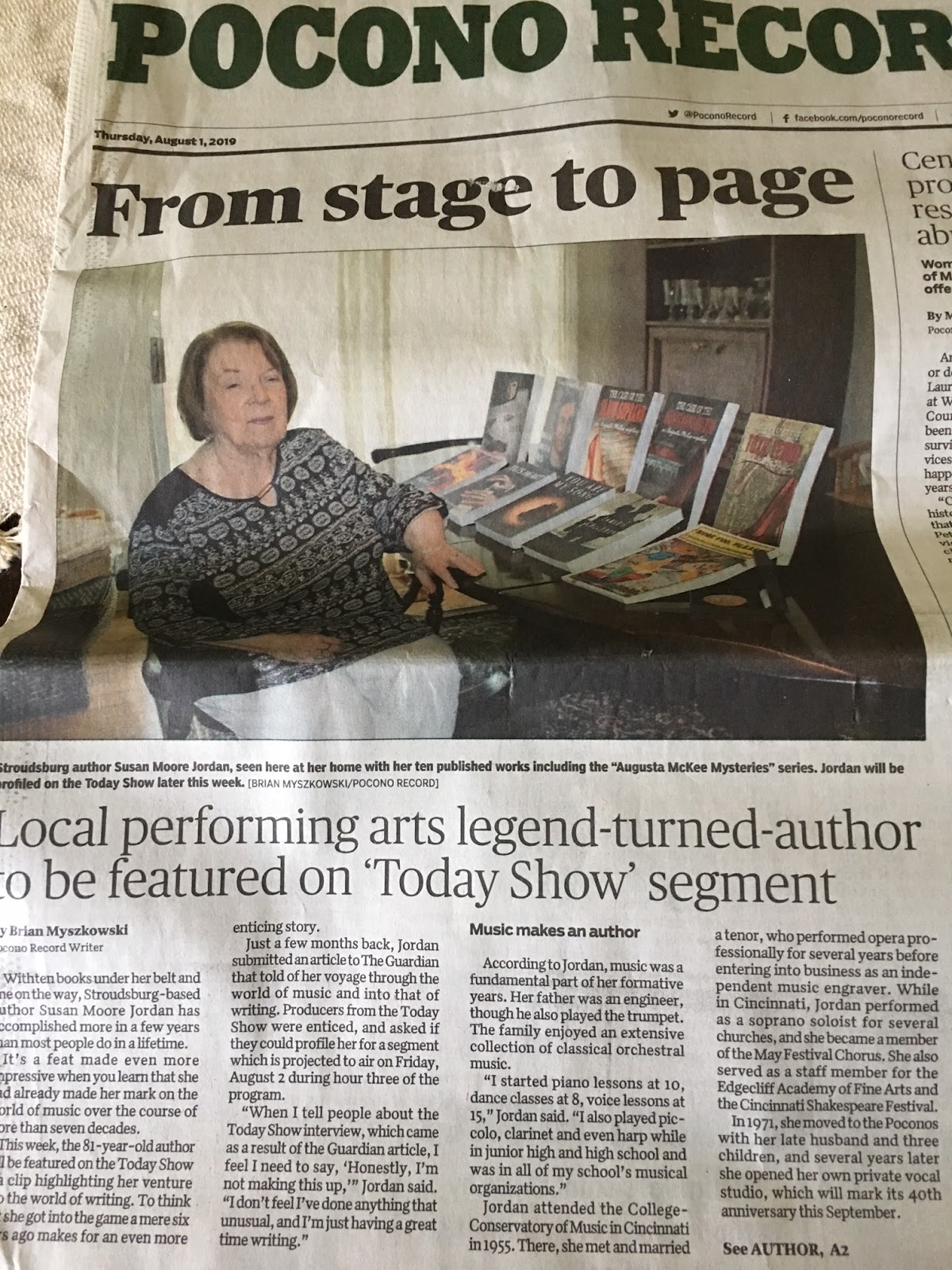
How about that? Front page, above the fold.

We’re about to enter the third decade of the millennium that I at one time doubted I’d ever see. I guess I should try to say something pithy and meaningful at this point. How about this, a quote from the great Yogi Berra: “It ain’t over ’til it’s over.”

Wishing you all the best for the coming year. Peace, hope, and love.


Please check out my author page on Amazon:
or visit my website, which has links to purchase all the books. The novels are also available as e-books.

Friday, November 8, 2019

The War That Is Still With Us


During 2016 and 2017, I spent a lot of time in Vietnam. Figuratively, that is; I was researching and writing two novels about the Cameron brothers, Andrew and Jake, who both fought in that conflict. My books Memories of Jake and Man with No Yesterdays are about the impact of Vietnam on their lives and the lives of those they loved.

The Vietnam War became, in a way, my war. Those two years were a dark journey into a stain on our nation’s history that remains to this day. It was a difficult, emotional, soul-searing journey, but at the end I was able to find glimmers of light that sometimes emerged from the darkness.

One of the best things to come from this venture was connecting with the remarkable Vietnam Veterans in our local chapter of the Vietnam Veterans of America. I am honored and humbled to now call some of these heroes “friend.” Connecting with retired U.S. Army Lt. Col. Charles Vincent was another. Col. Chuck was generous enough to act as my military consultant for the books, and again, I am honored to now consider him a friend.

Near the end of my research I stumbled upon a military operation which I had not previously been aware of, and wonder how many other Americans are not as well. A recent exchange with a new reader who has enjoyed my current mystery series books reinforced the emotion I experienced when learning about Operation Frequent Wind.

My character Jake Cameron is injured in a helicopter crash, and I wanted a photo of such a crash for the back cover of Man with No Yesterdays. An internet search led me to the stunning photo, and a further search made it possible for me to contact the photographer. Dr. Bertram Zarins, now an orthopedic surgeon at Massachusetts General Hospital in Boston, took the photo during the fall of Saigon. He generously permitted me to use the picture.


The short version is that Task Force 76 ships waited in the South China Sea to accept evacuees who were ferried by helicopter from various points in Saigon. Americans and South Vietnamese were rescued while the North Vietnamese Army was marching relentlessly toward the city. Sadly, many South Vietnamese did not make it out. But the valiant efforts of the helicopter pilots … who flew continuously for some twenty-four hours …resulted in some seven thousand lives being saved.

Devi Allen responded to a post on my Facebook author page about Man with No Yesterdays with this comment:

Looking forward to your Vietnam story. Since I was a protester at Berkeley when hubby had already served his time, we don't discuss it. But we did both find this display at the USS Midway Museum in San Diego touching. A note from a Vietnamese pilot, tossed onto the deck of the Midway as the evacuation took place. Written on one of the fabric maps they used for navigation. There is an accompanying audio-video of the event spoken by an officer on deck. Spoiling the plot, this pilot subsequently landed on deck, and his pregnant wife and 4 or 5 children spilled out of the one-seater plane onto the flight deck. Gave me chills.”

Reading this gave me chills as well. There were too many helicopters for the ships to handle, and a number had to be abandoned. Which is what resulted in Dr. Zarins dramatic photo … a chopper being ditched into the South China Sea. Others were flown onto the ships and pushed off, which is what I believe happened in Devi’s story … a South Korean pilot saving his family.

OPERATION FREQUENT WIND. A fitting finale to our helicopter war. A light in the darkness.


Man with No Yesterdays is available on Amazon, Kindle and paperback. See my website for additional information and links to all my books. www.susanmoorejordan.com

NOTE: there are a number of gripping videos on YouTube showing this operation, as well as excellent information on line. 


Monday, September 30, 2019

Tell Me Again Why I'm Doing This?


"Give someone a book, they'll read for a day. Teach someone how to write a book, they'll experience a lifetime of paralyzing self doubt."—Lauren DiStefano, author of Burning Kingdoms

Book number eleven, novel number ten, “Augusta McKee Mystery” number four, is waiting for me to hit that magical “Publish My Book” button on Kindle Direct Publishing. Yikes. 

 Every time I get to this point, I have this moment. What in the world am I doing? Despite all the edits, proofreads, read-throughs by beta readers, this book has to have mistakes in it. Beginning with the entire concept of the story. I should just sneak away and forget about releasing it – despite the fact I’ve already announced that it will be available October 1. Two days from today. 
 What would happen if I reneged, other than my having a large amount of egg on my face? The sun’ll come up tomorrow. (I know you sang that, I just did.) Grass will grow, flowers will bloom, the rivers will continue to run.

This is my child, my precious child, I’m about to push out into the cold, cruel world. Will it get a cold shoulder or a welcoming reception? Will anybody read it? Will the people who read it like it? Maybe I should let it stay home today. Or for a month. Or forever. I’ll read it.

My author friends assure me all of us go through this period of self-doubt. That’s really kind of a mild way of putting it. It’s more like a sense of “whatever possessed me to sit down at my computer and start putting words together when I have no idea what I’m doing and I have absolutely no business doing this.”

And if you think it will get better with time, I fervently hope you are correct, because at this point it’s gotten worse with every book. While I’m writing it, I have the greatest time imaginable. I completely lose myself in the book. My characters take over my life. I dream about them. I tell them to please go sit in the corner so I can go to the bank and avoid wrecking my car in the process. I’m sure I walk right past friends in the supermarket and don’t even see them because Augusta or Malcolm is talking to me about a plot point. And before those two, it was Andrew and Jake Cameron. They had my attention for over two years. 

Oh, I will follow through and click on that box, and watch The Case of the Purloined Professor go live on Amazon, and I’ll spread the word via social media that it’s available. And wait anxiously for the first reviews (and wish more people would kindly consider writing even a couple of lines for a review … we just never get enough, unless our name is Stephanie Meyer or John Grisham or Stephen King. Or the ex-billionaire, J. K. Rowling).

I truly am enjoying writing this mystery series. I like Augusta McKee and Malcolm Mitchell and their friends and family. It’s a thrill to feel that Augusta has a following, and I hope it continues to grow. I love that I’m learning so much about police work, its demands and intricacies (with many, many thanks to Stephen Kramer and the Greater Cincinnati Police Historical Society and Museum), and the limitations policing had in the mid-1960s—despite which they did remarkable work. Our law enforcement officers are dedicated, effective, and some of the bravest people on

the planet.

 There’s my answer … I do it because I love what I’m learning, and I love being able to share it with the nice people who read my books. After all, that’s what art is. A means of sharing our passion, whether it’s art, music, dance, theater, or literature. And I’m blessed with the desire and, it seems, the ability to share my passion for music through literature.

Yes, I guess I just answered my own question. Get ready, The Case of the Purloined Professor. You can do this. October first! Get out there and do your stuff!

Thank you for your support, dear reader. It means more than you know.